
 by
by Introduction
Taxonomy is the branch of biology that deals with the identification, naming, classification, and organization of living organisms. It helps scientists study the vast diversity of life by grouping organisms based on their similarities and differences. Taxonomy provides a universal system for naming organisms and understanding their evolutionary relationships.
The term taxonomy was introduced by the Swiss botanist Augustin Pyramus de Candolle in 1813. It is derived from the Greek words taxis (arrangement) and nomos (law).
Importance of Taxonomy
Taxonomy is important because it:
- Helps identify and distinguish organisms.
- Provides scientific names that are accepted worldwide.
- Organizes organisms into groups for easier study.
- Shows evolutionary relationships among species.
- Facilitates communication among scientists globally.
- Assists in biodiversity conservation and ecological studies.
Objectives of Taxonomy
The main objectives of taxonomy are:
- Identification of organisms.
- Classification of organisms into groups.
- Nomenclature (scientific naming).
- Understanding evolutionary relationships.
- Maintaining biological records and databases.
Components of Taxonomy
1. Identification
Identification involves recognizing and determining an organism’s characteristics and assigning it to a known group.
2. Classification
Classification is the process of arranging organisms into categories based on shared characteristics.
3. Nomenclature
Nomenclature is the system of giving scientific names to organisms according to international rules.
Hierarchical Classification System
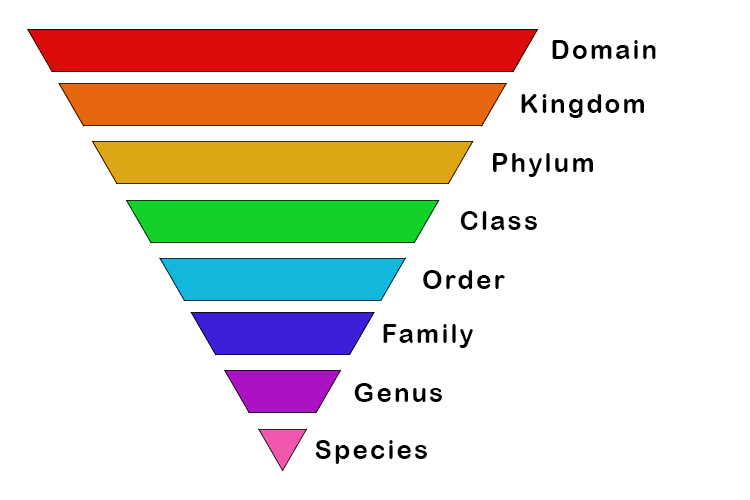
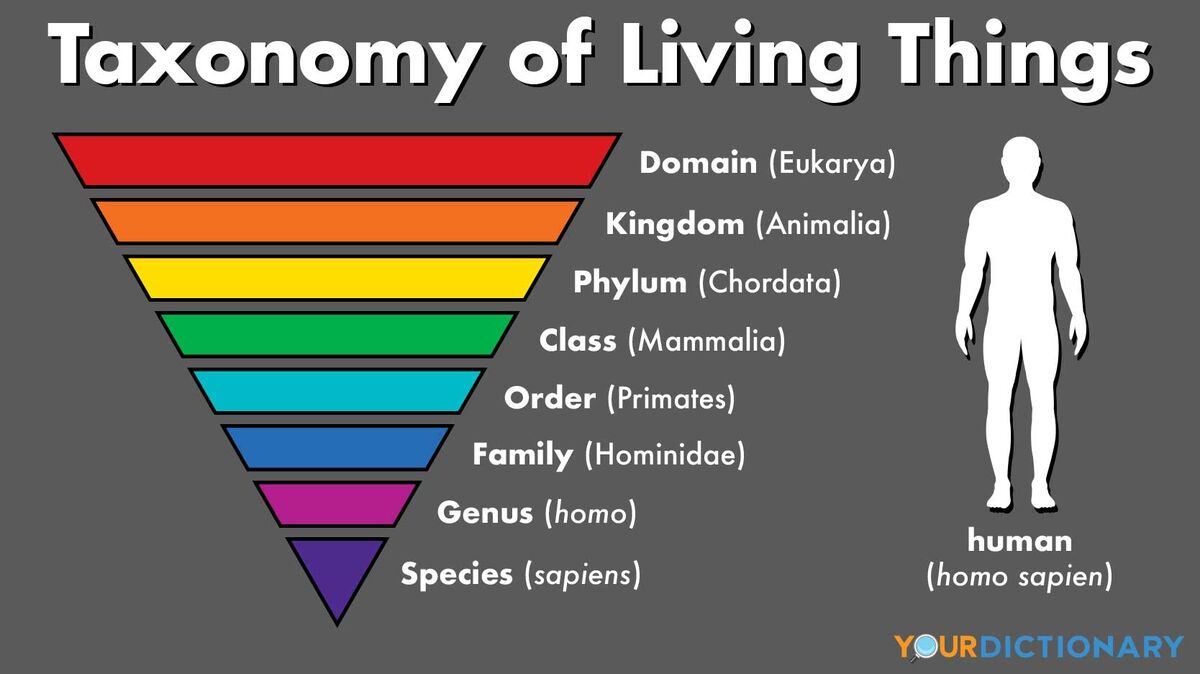
The modern classification system consists of several taxonomic ranks arranged from broad to specific.
| Taxonomic Rank | Example (Human) |
|---|---|
| Domain | Eukarya |
| Kingdom | Animalia |
| Phylum | Chordata |
| Class | Mammalia |
| Order | Primates |
| Family | Hominidae |
| Genus | Homo |
| Species | Homo sapiens |
Species
Species is the basic unit of classification. Organisms belonging to the same species can interbreed and produce fertile offspring.
Binomial Nomenclature
The system of scientific naming was developed by the Swedish scientist Carl Linnaeus.
Rules of Binomial Nomenclature
- Each organism has two names:
- Genus name
- Species name
- The genus name starts with a capital letter.
- The species name starts with a small letter.
- Scientific names are written in italics when printed.
- If handwritten, both words are underlined separately.
Examples
| Organism | Scientific Name |
|---|---|
| Human | Homo sapiens |
| Mango | Mangifera indica |
| House Cat | Felis catus |
| Lion | Panthera leo |
Types of Taxonomy
1. Alpha Taxonomy
Deals with the discovery, description, and naming of organisms.
2. Beta Taxonomy
Focuses on arranging organisms into natural groups and categories.
3. Gamma Taxonomy
Studies evolutionary relationships and variations among organisms.
Modern Taxonomy
Modern taxonomy uses multiple sources of information, including:
- Morphological characteristics
- Anatomical features
- Embryological evidence
- Cytological studies
- Biochemical data
- Molecular biology and DNA analysis
These techniques provide more accurate classification and help determine evolutionary relationships.
Five Kingdom Classification
Proposed by Robert H. Whittaker in 1969.
| Kingdom | Characteristics |
|---|---|
| Monera | Prokaryotic organisms |
| Protista | Simple eukaryotes |
| Fungi | Heterotrophic organisms with cell walls |
| Plantae | Multicellular photosynthetic organisms |
| Animalia | Multicellular heterotrophic organisms |
Three-Domain System
Developed by Carl Woese in 1990.
| Domain | Characteristics |
|---|---|
| Archaea | Ancient prokaryotes |
| Bacteria | True bacteria |
| Eukarya | Organisms with true nuclei |
Applications of Taxonomy
Taxonomy is widely used in:
- Agriculture
- Forestry
- Medicine
- Biotechnology
- Environmental science
- Wildlife conservation
- Biodiversity management
Conclusion
Taxonomy is a fundamental branch of biology that provides a systematic framework for identifying, naming, and classifying living organisms. It enables scientists to understand biodiversity, evolutionary relationships, and the natural organization of life. Modern taxonomy combines traditional observations with advanced molecular techniques, making it an essential tool in biological research and conservation efforts.
