 by
by Introduction
In today’s digital world, computers and devices need to communicate with one another to share information and resources efficiently. One of the most common networking systems used for this purpose is the Local Area Network (LAN). LAN technology plays a vital role in homes, schools, offices, universities, hospitals, and businesses by allowing multiple devices to connect and exchange data within a limited geographical area.
A Local Area Network is one of the fundamental concepts in computer networking and serves as the backbone of modern communication systems. This blog provides a detailed overview of LAN, including its definition, components, types, advantages, disadvantages, applications, and importance in the modern world.
What is a Local Area Network (LAN)?
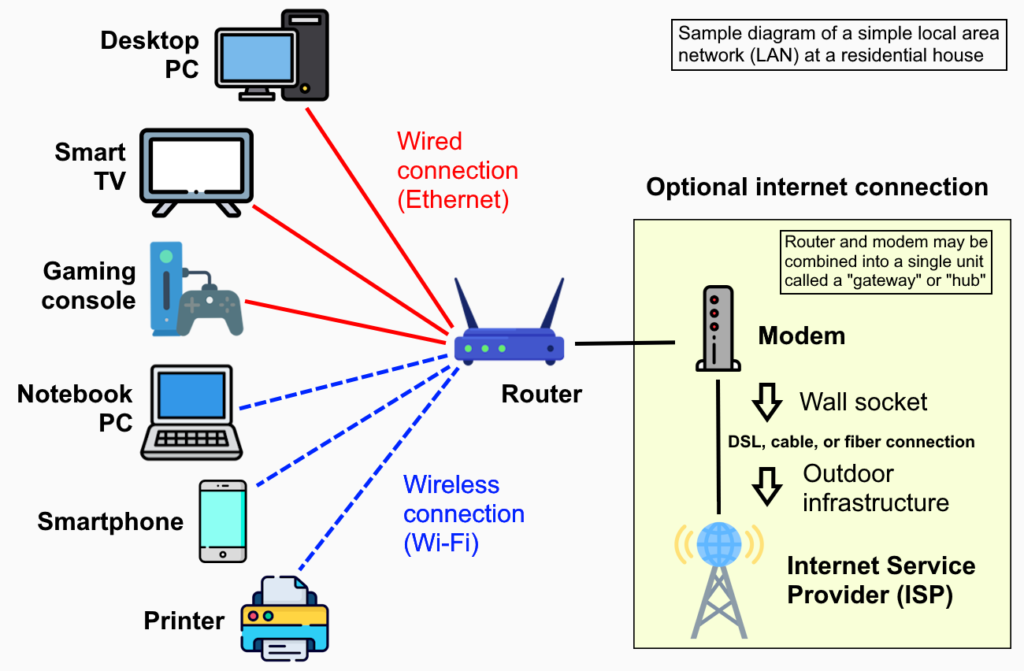
A Local Area Network (LAN) is a network that connects computers, printers, servers, smartphones, and other devices within a small geographical area such as a home, office building, school, or campus.
The primary purpose of a LAN is to enable devices to share resources, exchange data, and communicate with one another quickly and securely.
Definition
“A Local Area Network (LAN) is a network of interconnected devices within a limited area that allows users to share information, files, applications, and hardware resources.”
History of LAN
The concept of LAN emerged during the 1970s when organizations needed a way to connect multiple computers.
Key Milestones
| Year | Development |
|---|---|
| 1970s | Early networking technologies introduced |
| 1973 | Ethernet technology developed |
| 1980s | LAN adoption increased in businesses |
| 1990s | LAN became common in schools and offices |
| 2000s | Wireless LAN (Wi-Fi) became popular |
| Present | High-speed Gigabit and wireless LANs widely used |
Today, LAN technology continues to evolve with faster speeds, better security, and wireless connectivity.
Characteristics of LAN
A Local Area Network has several unique characteristics:
1. Limited Geographic Area
LAN covers a small area such as:
- Home
- Office
- School
- Laboratory
- Building
2. High Data Transfer Speed
LAN provides fast communication between devices, often ranging from:
- 100 Mbps
- 1 Gbps
- 10 Gbps or more
3. Private Ownership
Most LANs are owned and managed by individuals or organizations.
4. Resource Sharing
Users can share:
- Files
- Printers
- Internet connections
- Applications
- Storage devices
5. Low Cost
Compared to larger networks, LAN installation and maintenance costs are relatively low.
Components of a LAN
Several hardware and software components work together to create a Local Area Network.
1. Computers and Devices
These include:
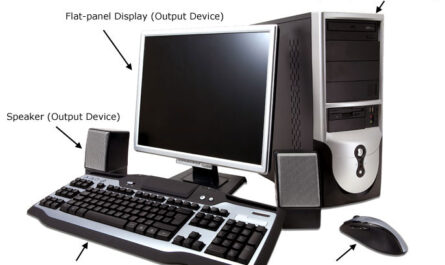
- Desktop computers
- Laptops
- Smartphones
- Tablets
- Servers
2. Network Interface Card (NIC)
A NIC allows a device to connect to the network.
Functions:
- Sends data
- Receives data
- Provides a unique network address
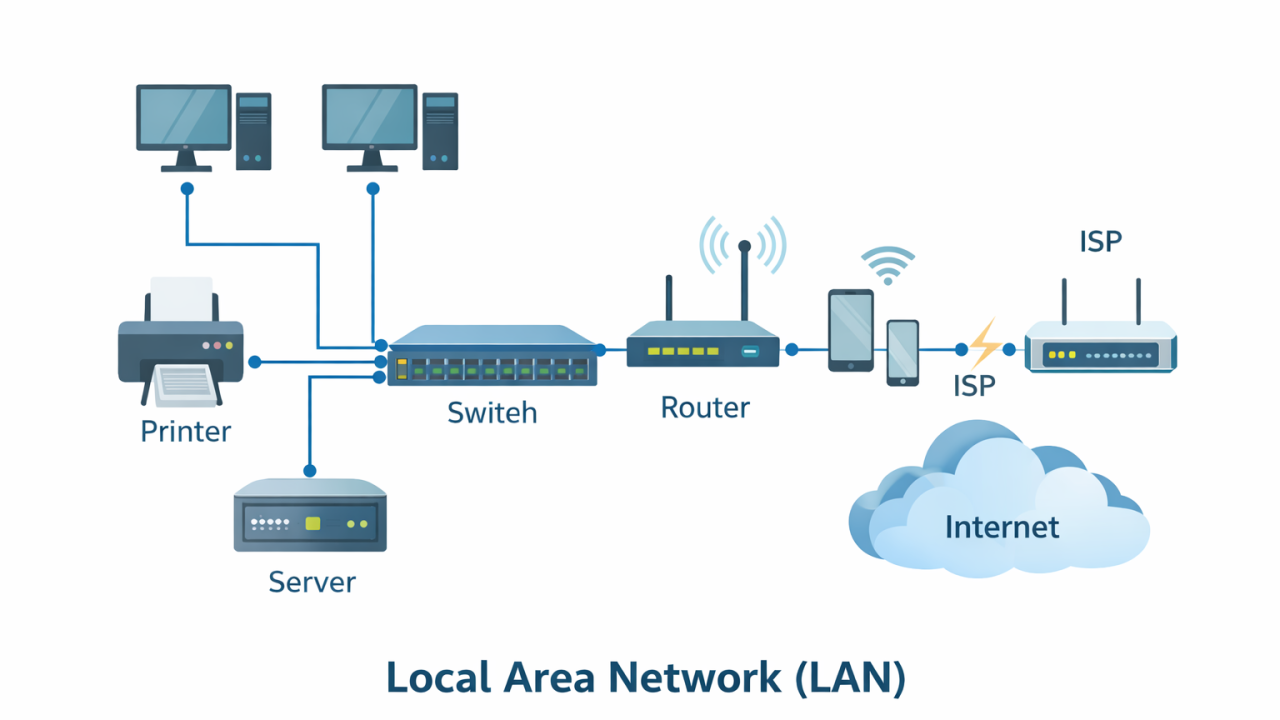
3. Switch
A switch connects multiple devices within the LAN and forwards data to the correct destination.
4. Router
A router connects the LAN to the internet and manages data traffic.
5. Cables
LANs may use:
- Ethernet cables
- Fiber optic cables
6. Wireless Access Point
Used in wireless LANs to provide Wi-Fi connectivity.
How Does a LAN Work?
A LAN works by connecting multiple devices through wired or wireless connections.
Step 1: Device Connection
Computers and devices connect to:
- Switches
- Routers
- Wireless access points
Step 2: Data Transmission
When a user sends data, the information travels through the network.
Step 3: Data Routing
The switch or router identifies the destination device and forwards the data.
Step 4: Data Reception
The receiving device processes and displays the information.
This entire process occurs within milliseconds, allowing fast communication.
Types of LAN
1. Wired LAN
A wired LAN uses Ethernet cables to connect devices.
Advantages
- High speed
- Reliable connection
- Better security
Disadvantages
- Requires cables
- Less flexibility
2. Wireless LAN (WLAN)
A Wireless LAN uses Wi-Fi technology instead of cables.
Advantages
- Mobility
- Easy installation
- Flexible connectivity
Disadvantages
- Signal interference
- Lower security compared to wired LAN
Advantages of LAN
1. Resource Sharing
Users can share:
- Printers
- Files
- Internet connections
This reduces hardware costs.
2. Fast Communication
LAN provides high-speed data transfer between connected devices.
3. Centralized Data Management
Organizations can store data on a central server, making management easier.
4. Cost Effective
Sharing resources minimizes expenses on equipment and maintenance.
5. Improved Collaboration
Employees and students can easily exchange files and information.
6. Enhanced Productivity
Quick access to data and resources increases efficiency and workflow.
Disadvantages of LAN
1. Security Risks
Unauthorized users may gain access if security measures are weak.
2. Virus Spread
Malware can spread quickly between connected devices.
3. Setup Costs
Initial installation may require:
- Cables
- Switches
- Routers
- Network administrators
4. Network Failure
If a central device fails, network operations may be disrupted.
5. Maintenance Requirements
Regular updates and monitoring are necessary to keep the network secure and efficient.
Applications of LAN
Schools and Universities
LAN allows:
- Access to educational resources
- File sharing
- Internet connectivity
Offices
Employees use LANs for:
- Email communication
- Shared printers
- Collaborative work
Hospitals
Hospitals use LANs to:
- Manage patient records
- Access medical equipment
- Share information securely
Banks
LAN helps banks:
- Process transactions
- Access databases
- Maintain secure communication
Homes
Home LANs connect:
- Computers
- Smartphones
- Smart TVs
- Gaming consoles
LAN vs Other Networks
| Feature | LAN | MAN | WAN |
|---|---|---|---|
| Full Form | Local Area Network | Metropolitan Area Network | Wide Area Network |
| Coverage Area | Small | City-wide | Global |
| Speed | High | Medium | Lower |
| Ownership | Private | Public/Private | Multiple Organizations |
| Example | Office Network | City Network | Internet |
Importance of LAN in Modern Computing
LAN is essential for modern computing because it enables efficient communication and resource sharing. Businesses rely on LANs for daily operations, educational institutions use them for learning, and homes use them for entertainment and internet access.
Without LAN technology, organizations would face difficulties in sharing information and managing digital resources efficiently.
Future of LAN Technology
LAN technology continues to improve with advancements such as:
- Gigabit Ethernet
- 10-Gigabit Networking
- Wi-Fi 6 and Wi-Fi 7
- Cloud Integration
- Network Automation
- Enhanced Cybersecurity
These innovations provide faster speeds, improved reliability, and stronger security.
Conclusion
A Local Area Network (LAN) is a crucial component of modern computer networking. It connects devices within a limited area, enabling users to share resources, communicate effectively, and access information quickly. LANs are widely used in homes, offices, schools, hospitals, and businesses due to their speed, efficiency, and cost-effectiveness. As technology advances, LANs will continue to play a significant role in supporting communication, collaboration, and digital transformation across the world.