 by
by Introduction
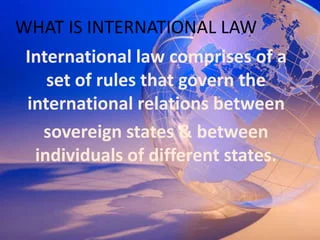
International law is a system of rules, principles, and agreements that govern the relationships between countries (states), international organizations, and, in some cases, individuals. It helps maintain international peace, security, cooperation, and justice by regulating how nations interact with one another.
Unlike national law, which is enforced by a country’s government, international law depends largely on the cooperation and consent of sovereign states. However, international courts, treaties, and organizations play a significant role in enforcing these rules.
Definition of International Law
International law can be defined as:
“A body of legal rules and principles that regulate the conduct of states, international organizations, and individuals in their relations with one another.”
According to the jurist L. Oppenheim:
“International law is the body of customary and conventional rules recognized as legally binding by civilized states in their intercourse with one another.”
Nature of International Law
International law has the following characteristics:
- It regulates relations between sovereign states.
- It promotes peace and cooperation.
- It is based on treaties, customs, and legal principles.
- It applies globally.
- It has no single world legislature or police force.
- Compliance often depends on the willingness of states.
Objectives of International Law
The main objectives are:
- To maintain international peace and security.
- To promote friendly relations among nations.
- To protect human rights.
- To regulate international trade and commerce.
- To protect the environment.
- To settle disputes peacefully.
- To encourage international cooperation.

Sources of International Law
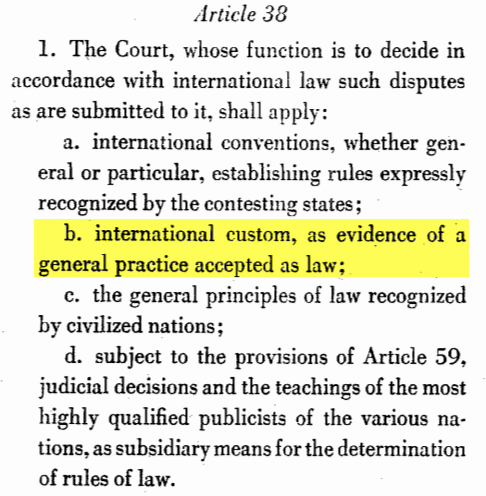
The primary sources of international law are listed in Article 38(1) of the Statute of the International Court of Justice (ICJ).
1. International Treaties
Treaties are written agreements between states.
Examples:
- Paris Agreement
- Geneva Conventions
- United Nations Charter
Importance
- Legally binding.
- Clearly define rights and duties.
- Promote international cooperation.
2. International Custom
Customary international law develops from:
- Consistent state practice.
- Belief that the practice is legally required (Opinio Juris).
Examples
- Diplomatic immunity.
- Freedom of the seas.
- Respect for national sovereignty.
3. General Principles of Law
These are legal principles recognized by most legal systems.
Examples include:
- Good faith
- Justice
- Equality before the law
- Fair hearing
- Responsibility for wrongful acts
4. Judicial Decisions
Judgments of international courts help interpret international law.
Examples:
- International Court of Justice
- International Criminal Court
5. Writings of Publicists
The opinions of respected legal scholars assist courts in interpreting international law.
Examples include the writings of:
- Hugo Grotius
- Lassa Oppenheim
Subjects of International Law
1. States
States are the primary subjects because they possess sovereignty.
Rights
- Independence
- Equality
- Territorial integrity
- Self-defense
Duties
- Respect treaties
- Avoid aggression
- Protect human rights
- Settle disputes peacefully
2. International Organizations
Examples include:
- United Nations
- World Health Organization
- World Trade Organization
These organizations help states cooperate on global issues.
3. Individuals
Individuals are increasingly recognized under international law.
They may:
- Claim protection of human rights.
- Be prosecuted for international crimes.
Examples include crimes such as:
- Genocide
- War crimes
- Crimes against humanity
Types of International Law
A. Public International Law
Deals with relations between states and international organizations.
Examples:
- Human rights
- Maritime law
- Environmental law
- Law of war
B. Private International Law
Also called Conflict of Laws.
It deals with legal disputes involving individuals or companies from different countries.
Examples:
- International marriage
- International business contracts
- Child custody disputes
Branches of International Law
1. International Human Rights Law
Protects the rights and freedoms of every individual.
Examples:
- Right to life
- Freedom of speech
- Freedom of religion
- Right to education
2. International Humanitarian Law
Applies during armed conflicts.
Purpose:
- Protect civilians.
- Protect prisoners of war.
- Limit methods of warfare.
Main source:
- Geneva Conventions
3. International Criminal Law
Punishes serious international crimes.
Crimes include:
- Genocide
- War crimes
- Crimes against humanity
- Aggression
4. International Environmental Law
Protects the global environment.
Examples:
- Climate change agreements
- Pollution control
- Wildlife protection
5. Law of the Sea
Regulates oceans and maritime activities.
Governed mainly by:
- United Nations Convention on the Law of the Sea
6. International Trade Law
Regulates trade between countries.
Covers:
- Tariffs
- Imports
- Exports
- Trade disputes
Principles of International Law
Major principles include:
- Sovereign equality of states.
- Peaceful settlement of disputes.
- Non-intervention in internal affairs.
- Respect for territorial integrity.
- Self-determination of peoples.
- Good faith.
- Respect for international obligations.
- Prohibition of the use of force except in lawful circumstances.
Enforcement of International Law
International law is enforced through:
- International courts.
- Arbitration.
- Diplomatic negotiations.
- Economic sanctions.
- Decisions of the United Nations Security Council.
- International cooperation.
Advantages of International Law
- Promotes world peace.
- Encourages international cooperation.
- Protects human rights.
- Facilitates international trade.
- Protects the environment.
- Resolves international disputes peacefully.
- Establishes legal standards for global conduct.
Disadvantages of International Law
- No central global government.
- Enforcement mechanisms are sometimes weak.
- Powerful states may ignore certain rules.
- Compliance often depends on political will.
- International legal proceedings can be slow.
Importance of International Law
International law is essential because it:
- Maintains peace and international order.
- Protects weaker states from unlawful actions.
- Promotes justice and equality among nations.
- Safeguards human rights worldwide.
- Encourages economic development through stable trade rules.
- Addresses global challenges such as climate change, terrorism, pandemics, and cybercrime.
- Provides peaceful methods for resolving international disputes.
Examples of International Law in Practice
- Countries sign treaties to reduce greenhouse gas emissions.
- States settle border disputes through the International Court of Justice instead of using force.
- The International Criminal Court prosecutes individuals accused of genocide or war crimes.
- International humanitarian rules protect civilians during armed conflicts.
Conclusion
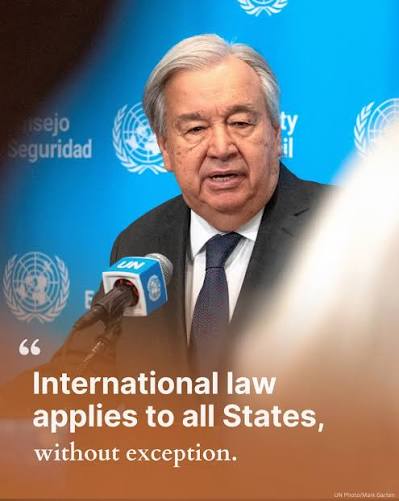
International law is the legal framework that governs relations among states, international organizations, and, increasingly, individuals. It is based on treaties, customs, and recognized legal principles. Although it relies heavily on state cooperation and does not have a single global enforcement authority, it plays a crucial role in promoting peace, protecting human rights, regulating international trade, preserving the environment, and resolving disputes. As the world becomes more interconnected, international law continues to evolve and remains indispensable for maintaining stability, justice, and cooperation among nations.
